Lesson 1 / 5 in Product & Development
4 Survival Strategies for the Next 6 Months from a Million-Dollar App Store Developer
TL;DR
In an era where anyone can build an app with vibe coding, surviving on the App Store is not about building more -- it is about marketing more deliberately.
4 Survival Strategies for the Next 6 Months from a Million-Dollar App Store Developer
One-Line Summary
In an era where anyone can build an app with vibe coding, surviving on the App Store is not about building more -- it is about marketing more deliberately.
Key Numbers & Data
| Metric | Value | Context |
|---|---|---|
| App Store submission rejection rate | 25% | About 25% of approximately 7.77 million app submissions in 2024 were rejected (tightened to 15% in 2025) |
| AI coding tool usage rate | 92% | 92% of US developers use AI coding tools daily as of 2026 |
| Adam Lyttle cumulative revenue | Over 1 million USD | Surpassed 1 million USD in cumulative App Store revenue with a portfolio of 50+ apps |
| Monthly revenue | 50,000 USD/month | Indie developer who went from 200,000 USD in debt to 50,000 USD monthly revenue |
| App search download ratio | 65% | 65% of app downloads occur immediately after App Store searches |
Background: Why This Matters
Since late 2025, a fundamental shift has been happening in the app development ecosystem. With the emergence of 'Vibe Coding,' even people who do not know how to code can now build apps using natural language prompts alone. Coined by Andrej Karpathy in early 2025, this term has become so mainstream that it was nominated for Collins Dictionary's 'Word of the Year.'
The problem is that as entry barriers disappear, low-quality apps have started flooding the App Store. Much like the early days of drop shipping, a mindset of 'build fast, build many, make money' is spreading. Apple has recognized this and enacted guideline revisions in November 2025 to crack down on clone apps. Rising rejection rates and increasing account suspensions can be interpreted as Apple's move to protect the trust of the App Store ecosystem.
In this environment, let us look at how an indie developer who has actually generated over 1 million USD in App Store revenue plans to survive the next 6 months.
It matters that the person saying this is not a theorist. Adam Lyttle, an Australian indie developer, taught himself to code without a formal degree. Starting from a worst-case scenario of 200,000 USD in debt, he built a portfolio of 50+ apps, surpassed 1 million USD in cumulative App Store revenue, and has experienced 8 business exits. The key question is why someone who built up to 50,000 USD in monthly revenue by shipping one app per month is now doing a 180-degree pivot in strategy.
Related market data:
- About 25% of 7.77 million App Store submissions in 2024 were rejected, converging to 15% in 2025 with tightened guidelines (Source: Twinr.dev)
- About 40% of iOS app submissions are delayed or rejected due to preventable errors (Source: App Store Review statistics)
- 92% of US developers use AI coding tools daily in 2026, 82% globally use them at least weekly (Source: Industry statistics)
- 65% of app downloads occur immediately after App Store searches (Source: Apple Gadget Hacks)
- 20% increase in AI app-related 'false rejections' in 2025 due to ambiguous policy interpretation (Source: Appitventures)
- Apple Guideline 4.1(c) established November 2025 -- strengthened clone app and brand misuse regulations (Source: How2Shout)
- Non-compliant apps to be excluded from major search results starting March 2026 (Source: AppTweak)
Key Insights
1. Entry Barriers Vanish -- App Development Is Becoming 'Drop Shipping'
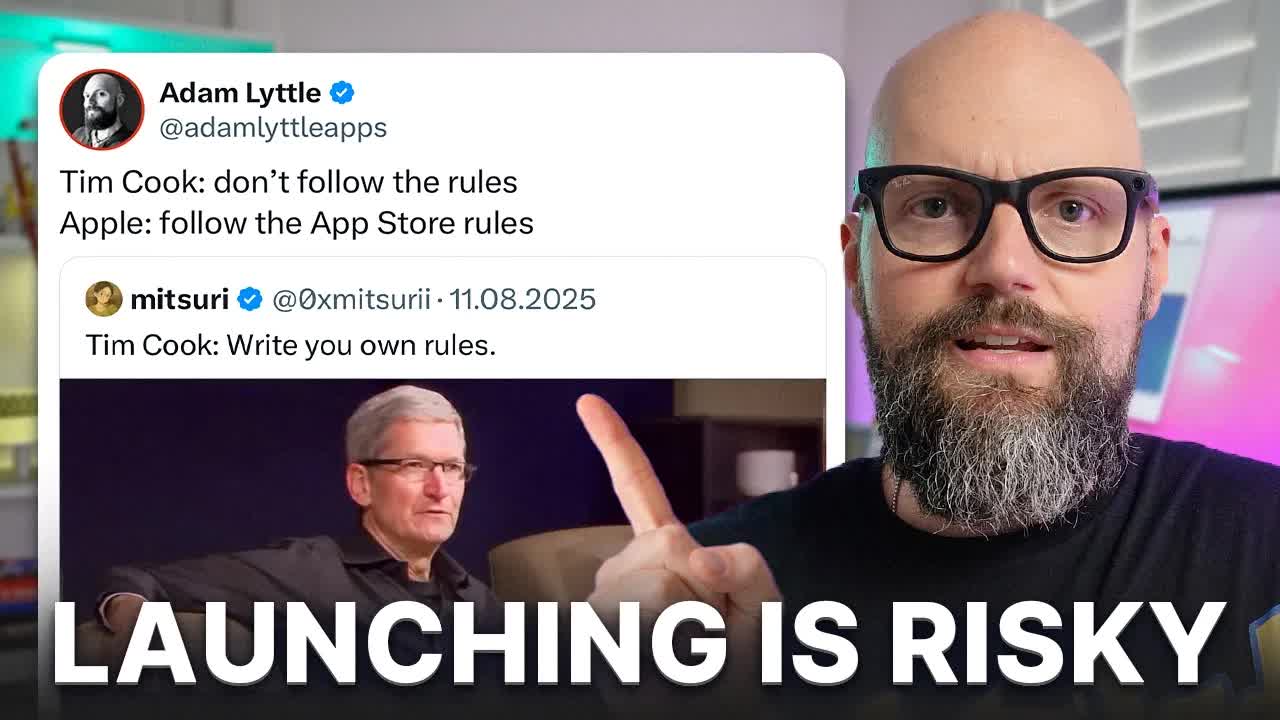
Just 6 months ago, launching an app was something of a milestone. But now, every launch comes with risk. Your app could be classified as spam, or worse, your entire Apple developer account could be suspended.
In the past, building an app required knowing how to code. You either learned it yourself or paid someone to do it. This entry barrier slowed people down. But now? Just type "Hey Claude, build me the next Spotify" and you are done.
For a while, this was a secret weapon for developers only. AI turned us into 10x developers virtually overnight -- what used to be one feature per week became 10. Leveraging developer skills to ship 10x more apps, expand App Store footprint, and earn more revenue -- it was the biggest arbitrage opportunity we had ever seen.
But something has shifted in the past few months. App development is going mainstream. The barrier has moved from 'how do I build it' to 'I built it, but how do I get people to know about it.' It is no longer a skill issue. It is a marketing issue.
"Building apps has this sort of get-rich-quick feeling about it. Like the early days of drop shipping."
"AI turned us into 10x developers pretty much overnight."
"It's no longer a skill issue. This is a marketing issue."
How to apply: Audit your app's competitive landscape. Search the App Store directly to see how many similar apps built with vibe coding already exist.
2. App Store Trust Is Eroding -- Users Are Starting to Hesitate Before Downloading
The motivation is subtly shifting. From 'let us build great software to make money' to 'let us make as much money as fast as possible.' When this shift happens, apps become bug-ridden, predatory sales tactics proliferate, and what marketing promises is not delivered inside the app.
Being honest, even as a developer, he has fallen into this pattern. Long onboarding flows that are essentially sales pitches, followed immediately by a paywall. At first only some apps did this, but now nearly every app downloaded follows the same formula.
Think from the user's perspective. The moment they see the 'In-App Purchases' tag, they know they will be asked to pay before even using the app. This makes them reluctant to browse the App Store at all. This is the core issue -- a loss of trust.
The only reason indie developers can succeed is because they are borrowing Apple's trust. Apple's marketplace attracts users who can download apps without worrying about viruses, scams, or handing over credit card information directly. But when users lose trust in this system? They stop browsing the App Store, stop searching, stop subscribing.
"The only reason why I'm a successful indie app developer is because I'm borrowing part of Apple's trust."
"When I see the in-app purchases tag, I know straight away that I'm going to be asked to pay before I've even used the app."
How to apply: Re-evaluate your app's onboarding and paywall experience from the user's perspective. Ensure you are providing sufficient free trial value.
3. The Hidden Meaning Behind Surging Rejections -- Apple Is Protecting the Ecosystem
Many developers are anxious watching Apple increase rejections, change policies, and suspend accounts. But if you shift perspective and look through Apple's eyes, the story changes.
Apple is trying to protect the long-term trust of the ecosystem. When you see it as a pattern, it becomes quite clear -- the bar is rising. Apple wants higher quality apps on the App Store.
In November 2025, Apple established Guideline 4.1(c) targeting clone apps, and announced that non-compliant apps would be excluded from major search results starting March 2026. They have even started factoring battery optimization into ranking.
You can view this change as a threat alone, but it is actually an opportunity too. A rising bar means apps that meet the standard can earn even greater rewards. The issue is that meeting this standard requires a different approach than before.
"I'm choosing to believe they're trying to protect the long-term trust of the ecosystem."
"The bar is rising. Apple wants higher quality apps on the App Store."
How to apply: Read Apple's latest App Review Guidelines carefully and create a checklist to ensure all your apps are compliant.
Tools mentioned:
- Apple App Review Guidelines - Check App Store review guidelines
4. Four Practical Strategies to Survive Until WWDC 2026
So what specifically should you do? Here are 4 strategies to execute over the next 6 months.
First, shift focus from building to marketing. Instead of building yet another app, invest time in marketing the ones you already have. Reduce ASO dependency and find additional user acquisition channels. This naturally forces you to build something substantial worth promoting. It is clear that a new skillset needs to be learned.
Second, do not chase new trends immediately. Wait until they are sufficiently validated and confirmed compliant. Too many cases of accounts getting suspended from riding the latest AI wave. Over the next 6 months, the goal is not to be first. It is to focus on what is proven.
Third, pay close attention to Apple's rejections and policy updates. Apple does not communicate much directly, but rejection reasons and policy changes tell the story. Spend more time keeping apps in compliance. The goal is to maintain good standing.
Fourth, slow down your launch cadence. This is the biggest change. Previously shipping one app per month, now it is every other month. Instead of building for the sake of building, the approach is more selective. Every new launch potentially triggers additional scrutiny from Apple. Instead of shipping more, ship more deliberately.
The goal is simple. Survive 6 months. Reach WWDC 2026 (scheduled for June). Listen to what Apple says. Understand the direction. And still be here when that time comes.
"Instead of building yet another app, I've invested that time into marketing the ones I already have."
"Over the next 6 months, I'm not trying to be first. I'm focusing on what's proven."
"Instead of shipping more, I'm shipping more deliberately."
How to apply: Organize your current app portfolio and invest 50% or more of this week's time in marketing existing apps rather than building new ones.
Action Checklist
Today:
- Conduct a full compliance check of all your apps against App Review Guidelines
- Assess the competitive landscape in your category on the App Store (including vibe-coded apps)
- Test your current app's onboarding and paywall flow from the user's perspective
This week:
- List 3 or more user acquisition channels beyond ASO (social media, communities, blogs, etc.)
- Select 1-2 existing apps with the highest growth potential relative to marketing investment
- Set up a routine to monitor Apple Developer News and policy updates
Long-term:
- Adjust new app launch cadence from monthly to every other month or longer
- Build marketing channels outside the app (TikTok, Instagram, etc.)
- Analyze WWDC 2026 (June) announcements and readjust strategy
References
Related Tools
| Tool | Purpose | Price | Link |
|---|---|---|---|
| Apple App Review Guidelines | Full app review criteria and guidelines | Free | Visit |
| AppTweak | ASO analysis and App Store optimization tool | From 69 USD/month | Visit |
| Appfigures | App Store analytics and keyword tracking | From 29.99 USD/month | Visit |
| Clipwing | Video production team service | Paid | Visit |
Related Resources
- How One Developer Turned Massive Debt into a 1M App Empire (Article) - Analysis of Adam Lyttle's journey from debt to a million-dollar app empire
- Apple App Store Rejection Reasons In 2025 (And Fixes) (Article) - Summary of major 2025 App Store rejection reasons and fixes
- Apple Updates App Store Review Guidelines: Clone Apps & AI (Article) - Analysis of Apple's November 2025 guideline update
- The Biggest App Store Algorithm Change is Here (Article) - App Store search algorithm changes and response strategies
- Indie App Marketing Strategies (2026): 10 Proven Plays (Article) - 10 strategies that actually work for indie app marketing in 2026
Fact-Check Sources
- App Store rejections are increasing → https://twinr.dev/blogs/apple-app-store-rejection-reasons-2025/
- Developer accounts being suspended every 2 weeks → https://developer.apple.com/support/terms/
- Anyone can build an app with vibe coding → https://news.microsoft.com/source/features/ai/vibe-coding-and-other-ways-ai-is-changing-who-can-build-apps-and-how/
- Surviving until WWDC 26 is the goal → https://www.macrumors.com/guide/wwdc-2026/
Questions to Consider
Is the app you are building right now closer to 'making money fast' or 'building great software'?
When a user downloads your app, is their first experience 'this is worth trying' or 'great, another paywall before I can even use it'?
Beyond App Store search, do you have your own channel to bring in users?
Key Takeaways
- 1Conduct a full compliance check of all your apps against App Review Guidelines
- 2Assess the competitive landscape in your category on the App Store (including vibe-coded apps)
- 3Test your current app's onboarding and paywall flow from the user's perspective
- 4List 3 or more user acquisition channels beyond ASO (social media, communities, blogs, etc.)
- 5Select 1-2 existing apps with the highest growth potential relative to marketing investment
- 6Set up a routine to monitor Apple Developer News and policy updates
- 7Adjust new app launch cadence from monthly to every other month or longer
- 8Build marketing channels outside the app (TikTok, Instagram, etc.)
- 9Analyze WWDC 2026 (June) announcements and readjust strategy
Want to read this later?
Save this insight to access it anytime
Original Video
앱스토어 100만 달러 개발자가 공개하는 6개월 생존 전략 4가지