Lesson 11 / 46 in Mindset & Wellness
5 Science-Backed Stress Relief Techniques That Work in Under 2 Minutes
TL;DR
Using 5 stress management techniques proven by psychology research, you can lower your heart rate and regulate cortisol levels in just 1-2 minutes.
5 Science-Backed Stress Relief Techniques That Work in Under 2 Minutes
TL;DR
Using 5 stress management techniques proven by psychology research, you can lower your heart rate and regulate cortisol levels in just 1-2 minutes.
Key Numbers & Data
| Metric | Value | Context |
|---|---|---|
| Global stress cost | 1 trillion USD annually | Productivity loss from depression/anxiety (WHO) |
| Workers experiencing stress | 84% | Experienced at least one mental health issue in past year |
| Breathing technique effect size | Medium to large | Meta-analysis shows slow breathing significantly regulates autonomic nervous system |
| Journaling effectiveness | 68% | 68% of journaling interventions showed valid results in systematic review |
| Smile recovery time | Under 30 minutes | Group receiving reward smiles returned cortisol to baseline within 30 min |
Context: Why This Matters
9 out of 10 modern people report experiencing extreme stress in the past year, and globally, productivity loss from stress reaches 1 trillion USD annually. 44% of workers feel more stressed than 5 years ago.
These techniques are not folk remedies. Slow breathing stimulates the vagus nerve to activate the parasympathetic nervous system, visualization suppresses amygdala overreaction, and according to facial feedback theory, smiling promotes dopamine and serotonin release. All have established neuroscientific mechanisms.
Key Insights
1. Slow Breathing Simultaneously Lowers Heart Rate and Muscle Tension

When stressed, most people breathe shallowly and rapidly. This "shallow chest breathing" raises heart rate further and stiffens muscles, creating a vicious cycle that amplifies stress.
Conversely, slow deep breathing stimulates the vagus nerve to activate the parasympathetic nervous system. According to a 2023 meta-analysis in Scientific Reports, breathing exercises significantly reduced self-reported stress, anxiety, and depression symptoms, with slow breathing being most effective at increasing heart rate variability (HRV).
The practice is simple: the 4-7-8 breathing method -- inhale through your nose for 4 seconds, hold for 7 seconds, exhale through your mouth for 8 seconds. Research shows just 3-5 minutes daily improves autonomic nervous system balance.
"Shallow chest breathing raises your heart rate and tenses your muscles. This makes you feel even more stressed."
How to apply: When you feel stress, try 3 rounds of 4-7-8 breathing (inhale 4 sec through nose - hold 7 sec - exhale 8 sec through mouth).
2. The Brain Cannot Distinguish Imagination from Reality -- The Power of Visualization

Guided imagery is more than just "imagine a pleasant scene." According to a 2021 study published in Evidence-Based Complementary and Alternative Medicine, guided imagery significantly promoted psychological relaxation along with progressive muscle relaxation and deep breathing.
The key is "detail." Rather than simply imagining "a beach," engaging all five senses -- the sound of waves, texture of sand, smell of ocean breeze -- maximizes the effect. When you focus on detailed description, the amygdala's stress response is suppressed and an actual relaxation response occurs.
Neuroscientifically, the brain cannot fully distinguish vivid imagination from actual experience. So even sitting in an office chair, closing your eyes for 2 minutes and vividly picturing your "peaceful place" triggers neurochemical responses similar to actually being there.
"Imagine a scene where all your stress is washing away, or picture yourself lying on a beach or reading a book in a garden."
How to apply: Choose your own "mental sanctuary" (beach, forest, cafe) and during stressful moments, close your eyes for 2 minutes and imagine it with all five senses.
3. Your Expression Creates Your Emotion -- The Science of Forced Smiling

Charles Darwin first proposed the "Facial Feedback Hypothesis," which has been substantially validated in modern psychology. The core logic is simple: expressions don't just reflect emotions -- they create them.
According to research published by the Association for Psychological Science, participants who smiled during stress tasks had lower heart rates during recovery than those maintaining neutral expressions. The Duchenne smile (genuine smile) group recovered fastest.
More interestingly, cortisol response varies by smile type. Reward smiles and affiliation smiles had stress-buffering effects, but dominance smiles actually increased cortisol and heart rate. Warm, genuine smiles are what matter.
Smiling triggers release of dopamine, serotonin, and endorphins. While smiling when you feel bad is not easy, scientifically, "just try smiling" actually works.
"Research shows that even forcing a smile can actually improve your mood."
How to apply: During stressful moments, intentionally smile for 10 seconds. Practicing in front of a mirror is even more effective.
4. Stress Is Stored in Your Jaw -- An Unexpected Physical Release Point

When stressed, tension accumulates in specific body parts. The most common yet overlooked area is the jaw and teeth. Unconscious jaw clenching (bruxism) is a classic physical stress response that can cause headaches, TMJ pain, and tooth damage.
There's a specific relaxation exercise: place your fingertips on the TMJ joint below your ears, clench your teeth while inhaling, hold, then slowly exhale while releasing. Consciously feeling the tension and relaxation in your jaw muscles is the key.
This technique is a condensed version of Progressive Muscle Relaxation (PMR), which involves intentionally tensing then releasing muscles. The jaw relaxation exercise is the most convenient way to apply this principle -- no tools or special location needed.
"Place your fingertips on the joint below your ears. Clench your teeth, inhale, hold your breath, then exhale while releasing."
How to apply: Stick a "jaw check" post-it on your monitor and do one jaw relaxation exercise every hour.
5. Just 15 Minutes of Writing Per Day Can Even Boost Immunity

Professor James Pennebaker of the University of Texas pioneered "Expressive Writing" research with decades of evidence. The core finding is surprisingly simple: writing emotions for just 15-20 minutes daily for 4 consecutive days improved immune function, reduced blood pressure, and decreased medical visits.
A systematic review found that 68% of journaling interventions produced valid results for mental health management. The mechanism lies in "emotional processing" -- organizing confused thoughts and feelings into writing triggers cognitive restructuring and safe release of suppressed emotions.
Grammar and style don't matter at all. Spelling mistakes, incomplete sentences, even profanity -- it's all fine. The key is "writing honestly without self-censorship."
"Writing provides a channel to express our feelings and helps release suppressed emotions."
How to apply: Tonight before bed, spend 10 minutes writing "emotions I felt today" uncensored in a notebook. Paper is recommended over digital.
Action Checklist
Do today:
- Try 3 rounds of 4-7-8 breathing right now (total 1 minute)
- Check if your jaw is clenched and release it
- Intentionally smile for 10 seconds
This week:
- Start 10-minute emotion journaling before bed nightly (prepare notebook and pen)
- Choose your own "mental sanctuary" and practice visualization 3 times
- Stick a "breathing + jaw check" post-it on your monitor
Long-term:
- From the 5 techniques, establish 2-3 that work best for you as routine
- Continue emotion journaling 4+ weeks for long-term stress reduction
- Learn the full PMR routine and practice 2-3 times per week
Reference Links
Source Material
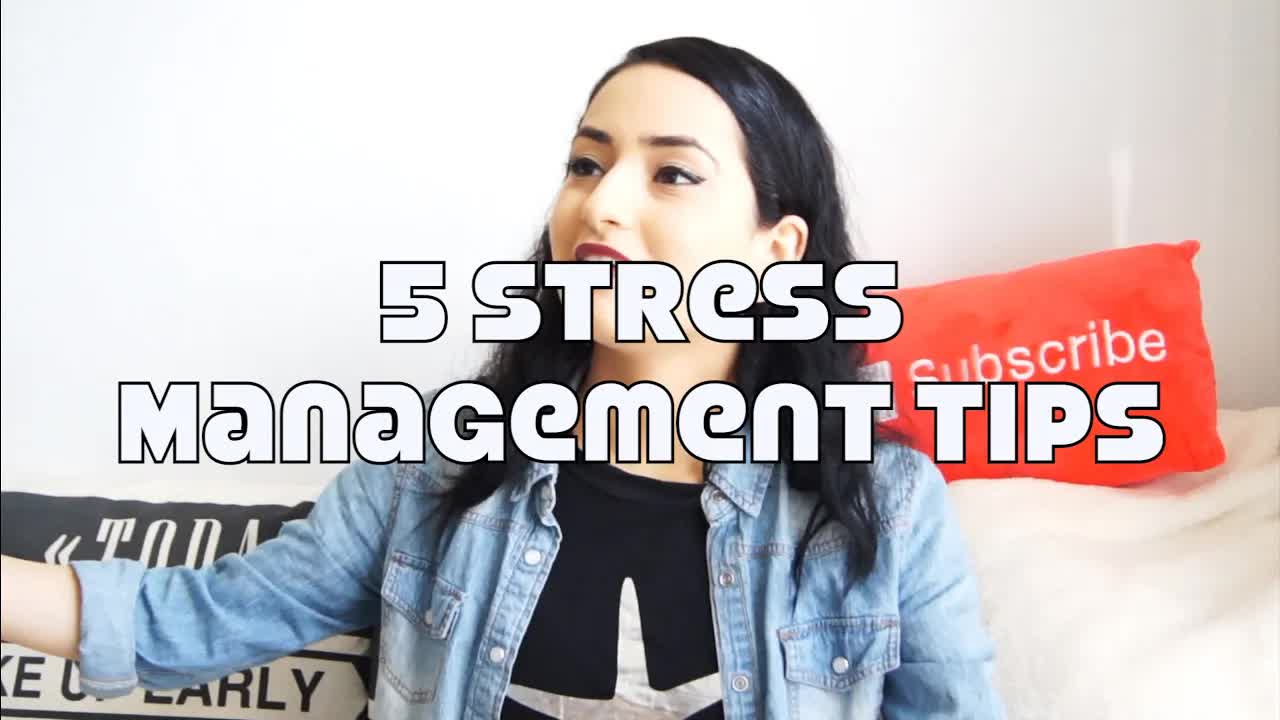
- Stress Management techniques - 5 Stress Management tips. Psych2Go Ft. Daria Azizian - Psych2Go (1:42)
Related Resources
- Breathwork for Stress: Meta-analysis of RCTs (Article) - Meta-analysis on breathing exercises for stress/anxiety/depression reduction
- Smiling Facilitates Stress Recovery (APS) (Article) - Experimental study on smiling facilitating stress recovery
- Efficacy of Journaling in Mental Illness Management (Article) - Systematic review of journaling effectiveness in mental health
Fact-Check Sources
- Deep breathing reduces stress -> https://www.nature.com/articles/s41598-022-27247-y
- Forced smiling improves mood -> https://www.psychologicalscience.org/news/releases/smiling-facilitates-stress-recovery.html
- Writing emotions releases suppressed feelings -> https://pmc.ncbi.nlm.nih.gov/articles/PMC8935176/
Questions to Consider
When you feel stress, which part of your body tenses up first? Are you aware of that signal?
Of the 5 techniques, which one could you start most easily right now?
Where is your "mental sanctuary"? What does it feel like when you picture it with all five senses?
Key Takeaways
- 1Try 3 rounds of 4-7-8 breathing right now (total 1 minute)
- 2Check if your jaw is clenched and release it
- 3Intentionally smile for 10 seconds
- 4Start 10-minute emotion journaling before bed nightly (prepare notebook and pen)
- 5Choose your own "mental sanctuary" and practice visualization 3 times
- 6Stick a "breathing + jaw check" post-it on your monitor
- 7From the 5 techniques, establish 2-3 that work best for you as routine
- 8Continue emotion journaling 4+ weeks for long-term stress reduction
- 9Learn the full PMR routine and practice 2-3 times per week
Want to read this later?
Save this insight to access it anytime