Lesson 19 / 46 in Mindset & Wellness
How 3 Minutes of Daily Mind Training Can Rewire Your Brain: A Neuroscientist's 4 Pillars of a Healthy Mind
TL;DR
University of Wisconsin neuroscientist Richard J. Davidson reveals four pillars of a healthy mind -- awareness, connection, insight, and purpose -- backed by fMRI evidence showing that just 7 hours of compassion meditation training produces measurable brain circuit changes.
How 3 Minutes of Daily Mind Training Can Rewire Your Brain: A Neuroscientist's 4 Pillars of a Healthy Mind
One-Line Summary
University of Wisconsin neuroscientist Richard J. Davidson reveals four pillars of a healthy mind -- awareness, connection, insight, and purpose -- backed by fMRI evidence showing that just 7 hours of compassion meditation training produces measurable brain circuit changes.
Key Numbers & Data
| Metric | Value | Context |
|---|---|---|
| Mind-wandering rate | 47% | Harvard study: percentage of waking hours American adults spend not focused on what they are doing |
| Loneliness prevalence | 76% | Percentage of US middle-aged adults reporting moderate to high loneliness |
| Depression increase in women | 33% | Increase in major depressive disorder diagnoses among women over 3 years |
| Time to brain change | 7 hours | Total compassion meditation training time after which fMRI detected brain circuit changes |
| Mortality risk without purpose | Over 2x | People in their 60s with low sense of purpose are over twice as likely to die within 5 years |
| Recommended daily practice | 3 minutes | Davidson's suggested minimum starting time for mind training |
Background: Why This Matters
Modern society faces an unprecedented mental health crisis. According to US CDC data from 2021-2023, depression prevalence increased 60% compared to 2013-2014, and teen suicide rates have more than doubled in the past decade. The World Health Organization (WHO) released a 2025 report stating that loneliness is associated with approximately 100 deaths per hour, or over 870,000 annually.
In this context, the scientific evidence that "the mind can be trained" is not just self-help advice but a public health solution. As neuroplasticity research has grown exponentially, evidence continues to mount that meditation and mindfulness can actually change the brain's structure and function. A systematic review published in November 2024 concluded that Mindfulness-Based Stress Reduction (MBSR) strengthens brain regions related to emotional processing and sensory perception.
Richard J. Davidson earned his psychology PhD from Harvard and has been teaching psychology and psychiatry at the University of Wisconsin-Madison since 1984. He is the founder and director of the Center for Healthy Minds, a pioneer in researching the neural basis of emotion and the scientific effects of meditation. Named one of TIME magazine's 100 Most Influential People in 2006, he was elected to the National Academy of Medicine in 2017. He has published over 400 academic papers and authored bestsellers including "Altered Traits" and "The Emotional Life of Your Brain."
Related market data:
- US adult depression prevalence increased 60% (2021-2023 vs 2013-2014) (Source: CDC)
- Loneliness linked to approximately 100 deaths per hour, over 870,000 annually (Source: WHO)
- Loneliness is over twice as strong a predictor of premature death as obesity (Source: multiple studies)
- Social isolation linked to 50% increased dementia risk, 29% increased heart disease risk, 32% increased stroke risk (Source: WHO)
- 4 in 10 US adults aged 45+ report feeling lonely (Source: AARP)
- Healthy Minds App users report 28% stress reduction, 18% anxiety reduction, 24% depression reduction with 5 minutes daily (Source: Healthy Minds Innovations)
Key Insights
1. The Dalai Lama's Question That Redirected a Neuroscientist's Entire Career

Early in his career, Richard Davidson focused on studying the brain circuits of negative emotions like stress, anxiety, and depression. His core question was why some people are vulnerable to life's adversities while others show greater resilience.
Then in 1992, everything changed when he met the Dalai Lama. The Dalai Lama asked: "If you can use the tools of modern neuroscience to study anxiety and fear, depression and stress, why can't you use the same tools to study kindness and compassion?" Davidson could only respond, "That's difficult." But he realized that studying anxiety and depression had been difficult at first too, and they had eventually made progress.
This encounter became a pivotal turning point in neuroscience history. Davidson's lab began systematically studying how positive human qualities -- kindness, compassion, gratitude, sense of purpose -- work in the brain and whether they can be strengthened through training. The foundation was the concept of neuroplasticity: our brains are constantly changing, but most of us remain unaware of these changes as we are passively shaped by external environments.
"Why can't you use the same tools of modern neuroscience to study kindness and to study compassion in addition to studying anxiety and fear and depression and stress?"
How to apply: Reflect on the ratio of time you spend focusing on negatives versus intentionally cultivating positives in your daily life.
2. Distraction, Loneliness, Negative Self-Talk, and Lost Purpose: Four Threats the Brain Faces Unprotected
The first crisis Davidson identifies is distractibility. According to the famous Harvard study by Killingsworth and Gilbert, American adults spend 47% of their waking hours thinking about something other than what they are currently doing. When researchers texted thousands of people throughout the day asking what they were doing, whether their mind was on the task or elsewhere, and how happy they felt, people were significantly less happy when their minds were wandering. The paper's title says it all: "A Wandering Mind Is an Unhappy Mind."
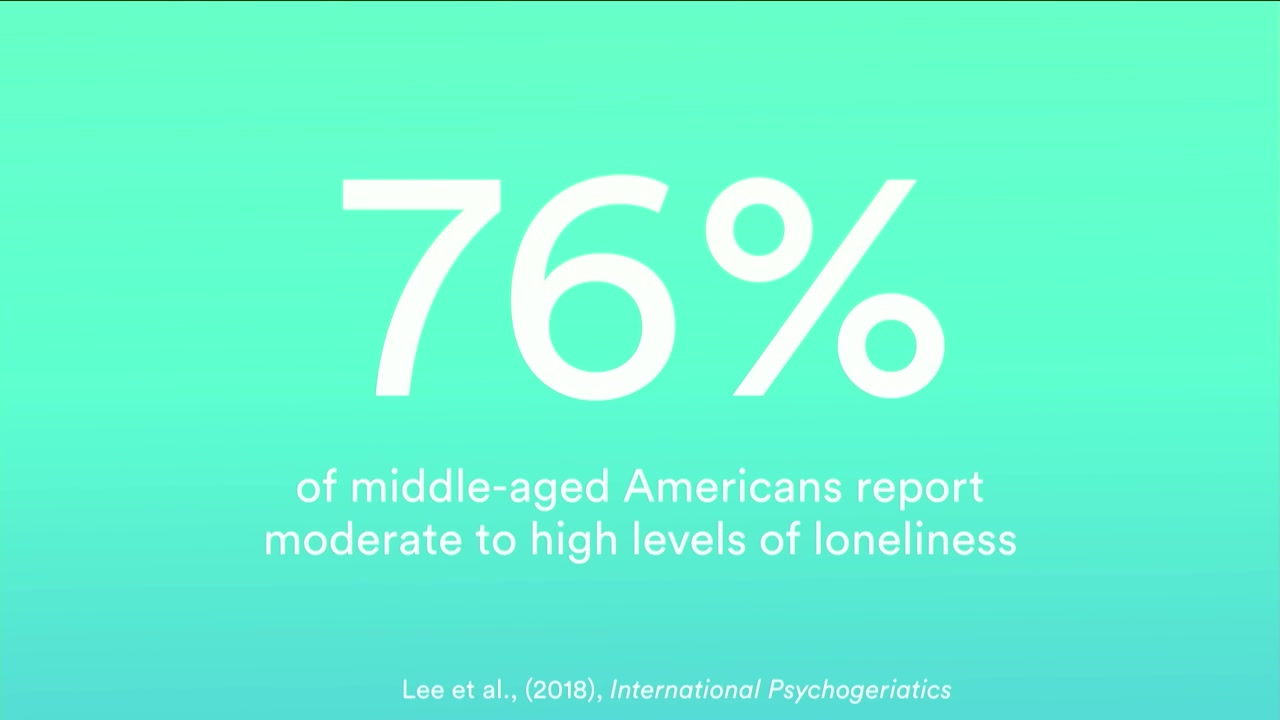
The second crisis is loneliness. Despite being more digitally connected than ever, 76% of US middle-aged adults report moderate or higher levels of loneliness. Loneliness is not just an emotion but directly impacts physical health -- recent research shows it is over twice as strong a predictor of premature death as obesity. The WHO's 2025 report states that loneliness is associated with 100 deaths per hour, over 870,000 annually.
The third crisis is negative self-talk and depression. Major depressive disorder diagnoses among women have increased 33% over the past three years, with the same trend appearing in teenagers aged 12-17. The fourth crisis is loss of purpose. People in their 60s with low sense of purpose are over twice as likely to die within five years compared to those with high purpose. The link between psychological well-being and physical health is remarkably strong.
"A Wandering Mind is an Unhappy Mind."
"Our nation is suffering not simply from a fiscal deficit but from an attention deficit."
How to apply: Ask yourself three times today: "Where is my mind right now?" Simply recognizing mind-wandering is the beginning of meta-awareness.
3. Awareness, Connection, Insight, Purpose: The Four Scientifically Validated Domains of Mind Training
Davidson's team distilled decades of research into four core elements of a healthy mind. This framework differs fundamentally from typical self-help advice because each element is linked to specific brain circuits and can be strengthened through training.
The first pillar is Awareness. It has two components: attention -- the ability to sustain focus and resist distraction -- and meta-awareness, which means knowing what your mind is doing. Everyone has had the experience of reading several pages of a book without remembering a single word. That is a failure of meta-awareness. The moment you realize "Oh, I was lost in thought" is meta-awareness in action. Davidson emphasizes this is "essential" for genuine change.
The second pillar is Connection. This encompasses qualities like gratitude, kindness, compassion, and positive outlook -- the qualities that nurture harmonious relationships. These already exist within us and can be activated and strengthened with just a little stimulation.
The third pillar is Insight. We all carry narratives about ourselves, and in extreme cases these become negative self-beliefs -- a prescription for depression. The key is not changing the narrative itself but changing your relationship to it. When the thought "I'm a failure" arises, instead of accepting it as fact, you step back and observe: "Ah, that thought is appearing right now."
The fourth pillar is Purpose. It is the sense that life is heading in a particular direction. The important thing is connecting more of your daily activities to this sense of purpose. Even taking out the trash or doing laundry can become meaningful when connected to your purpose.
"Meta-awareness is knowing what our minds are doing."
"A healthy mind entails changing our relationship to this narrative. Not so much changing the narrative itself but changing our relationship to it."
How to apply: Choose the pillar where you are weakest: Awareness (focus/meta-awareness), Connection (gratitude/kindness), Insight (relationship with self-narrative), or Purpose (linking daily activities to purpose).
Tool mentioned:
- Healthy Minds Program - Free meditation app developed by Davidson's Center for Healthy Minds, offering guided meditations based on the four pillars framework.
4. Just 2 Weeks (7 Hours) of Compassion Meditation Produced Visible Brain Circuit Changes on fMRI
Davidson distinguishes two types of learning to explain the core mechanism of mind training. Declarative learning is knowing "about" something. You can read books about the value of kindness, but that alone will not make you a kinder person. You can teach the value of honesty, but that does not produce honest people. Real change requires procedural learning. These two types of learning operate through entirely different brain circuits, and genuine transformation requires both.
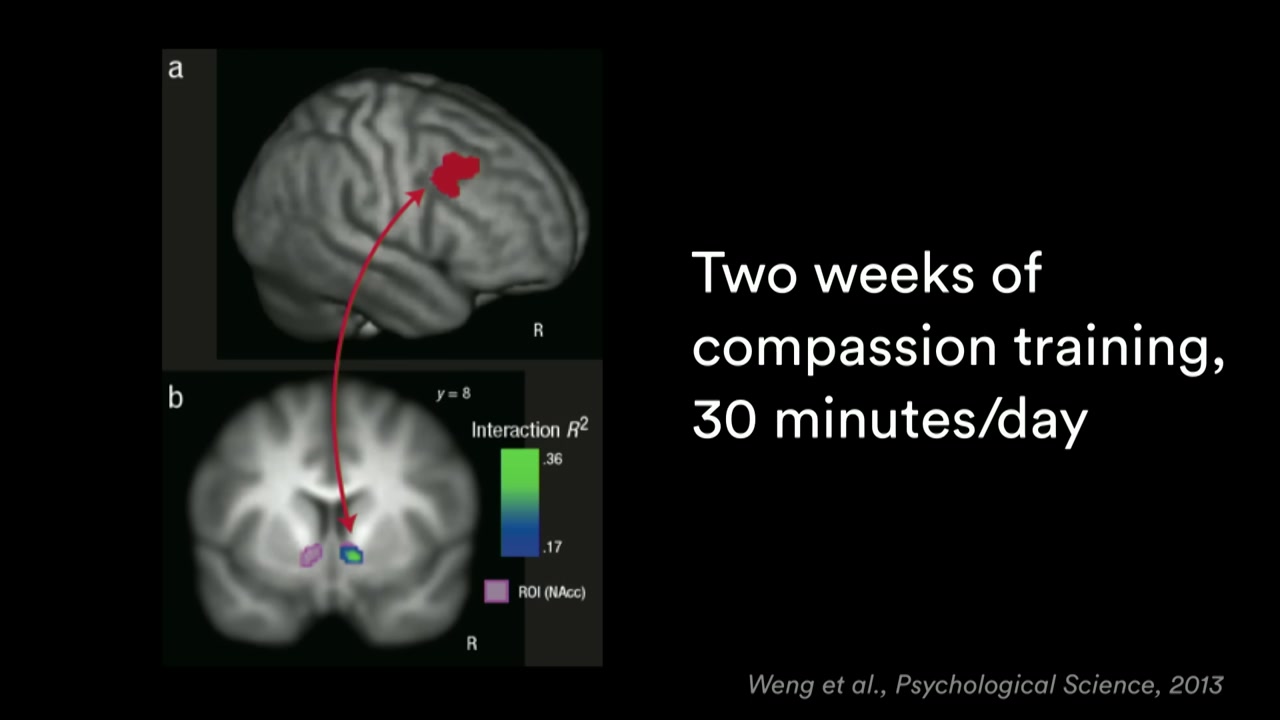
Research results support this. Young adults were randomly assigned to either a two-week compassion meditation training group or a cognitive therapy group, with fMRI brain scans before and after. After just 7 hours of practice, systematic differences emerged. Specifically, the circuit connecting the prefrontal cortex and ventral striatum -- important for certain positive emotions -- was strengthened. Follow-up research by the Wisconsin team confirmed that participants who displayed the most altruistic behavior were the same ones who showed the greatest brain changes when viewing human suffering.
These changes may not be permanent, but the key message is that change can begin, and through systematic practice, it can be sustained. Davidson calls this an "urgent public health need," emphasizing that just as brushing teeth is a learned behavior not encoded in our genes, mind training can become a daily habit.
"We can teach people the value of honesty, but this will not necessarily make them an honest person."
"Our brains can change in a remarkably rapid period of time."
How to apply: Recognize the gap between knowing about kindness and actually practicing it. Today, perform one intentionally kind act for someone and observe how your own emotions change.
5. Like Brushing Your Teeth: How 3 Minutes of Daily Mind Training Can Change the World

The most impressive part of Davidson's conclusion is its practicality. He does not prescribe 30-minute meditation sessions or hour-long yoga practices. Instead, he says to start with just 3 minutes a day. Just as no one brushed their teeth when humans first evolved but everyone does now, mind training can become a learned behavior. Starting the brain's change mechanisms does not require much time.
Moreover, you do not need to set aside special time. You can practice during your commute, while brushing your teeth, while drinking your first morning coffee, or while walking. It can be woven into routines you already have. Research data from the free Healthy Minds Program app developed by the Center for Healthy Minds shows that just 5 minutes of daily practice produces 28% stress reduction, 18% anxiety reduction, 24% depression reduction, and 13% increase in social connection.
Davidson emphasizes that individual practice can lead to larger social change. Connection training can reduce implicit bias, awareness training can improve academic achievement, and cultivating well-being itself can reduce healthcare costs while boosting productivity and focus. The simplest form of compassion meditation is thinking of someone you love and silently repeating "May they be happy and free from suffering." One minute is enough, and you can gradually extend it to people with whom you have difficult relationships.
"When human beings first evolved on this planet, none of us were brushing our teeth. And yet, today, we all do."
How to apply: For the next 3 days, during your morning tooth-brushing, silently repeat: "May the person I love be happy and free from suffering." Three minutes is all you need.
Tool mentioned:
- Healthy Minds Program - Free guided meditation app based on the four pillars, with up to 600 days of content.
Action Checklist
Do today:
- During morning or evening tooth-brushing, repeat the compassion phrase "May they be happy" for 3 minutes
- Ask yourself 3 times during the day: "Where is my mind right now?" (meta-awareness practice)
- When a negative self-narrative arises, observe: "Ah, that thought is appearing"
This week:
- Download the Healthy Minds Program app (free) and start your first 5-minute session
- Choose the weakest of the 4 pillars (awareness/connection/insight/purpose) to focus on
- Practice "connection" by intentionally expressing gratitude or kindness to one person per day
Long-term:
- Sustain 5-10 minutes of daily meditation for 30+ days (habit formation)
- Practice connecting all daily activities (cleaning, laundry, commuting) to your sense of purpose
- Read Richard Davidson's "Altered Traits" or "The Emotional Life of Your Brain"
Reference Links
References
- How mindfulness changes the emotional life of our brains | Richard J. Davidson | TEDxSanFrancisco - TEDx Talks (17:53)
Related Tools
| Tool | Purpose | Price | Link |
|---|---|---|---|
| Healthy Minds Program | Science-based meditation app from Center for Healthy Minds. Guided meditations based on the 4 pillars (awareness/connection/insight/purpose), 5-30 min sessions, seated and active meditations, up to 600 days of free content. iOS/Android. | Free (donation-based) | Visit |
Related Resources
- A Wandering Mind Is an Unhappy Mind (Killingsworth & Gilbert, 2010) (Article) - Harvard study: 47% of waking time spent mind-wandering, linked to decreased happiness
- Brain Can Be Trained in Compassion, Study Shows (Article) - U of Wisconsin study: altruistic behavior and brain changes after 2 weeks of compassion training
- Neurobiological Changes Induced by Mindfulness and Meditation (2024) (Article) - 2024 systematic review: MBSR strengthens brain regions for emotional processing
- Association Between Life Purpose and Mortality (JAMA, 2019) (Article) - Study of 6,985 adults: life purpose significantly linked to all-cause mortality
Fact-check Sources
- 47% of waking time spent mind-wandering -> https://www.science.org/doi/10.1126/science.1192439
- Loneliness is over 2x stronger predictor of premature death than obesity -> https://www.who.int/news/item/30-06-2025-social-connection-linked-to-improved-heath-and-reduced-risk-of-early-death
- 33% increase in major depression diagnoses among women in 3 years -> https://www.cdc.gov/nchs/products/databriefs/db527.htm
- 7 hours of compassion meditation training produces fMRI-visible brain changes -> https://news.wisc.edu/brain-can-be-trained-in-compassion-study-shows/
Questions to Consider
What percentage of your waking hours do you spend truly focused on the present moment? Are you better than the 47% average?
If there is a recurring narrative you tell yourself about who you are, is it a "fact" or a "thought pattern"?
If even taking out the trash and doing laundry can be connected to your life's purpose, what is that purpose?
Key Takeaways
- 1During morning or evening tooth-brushing, repeat the compassion phrase "May they be happy" for 3 minutes
- 2Ask yourself 3 times during the day: "Where is my mind right now?" (meta-awareness practice)
- 3When a negative self-narrative arises, observe: "Ah, that thought is appearing"
- 4Download the Healthy Minds Program app (free) and start your first 5-minute session
- 5Choose the weakest of the 4 pillars (awareness/connection/insight/purpose) to focus on
- 6Practice "connection" by intentionally expressing gratitude or kindness to one person per day
- 7Sustain 5-10 minutes of daily meditation for 30+ days (habit formation)
- 8Practice connecting all daily activities (cleaning, laundry, commuting) to your sense of purpose
- 9Read Richard Davidson's "Altered Traits" or "The Emotional Life of Your Brain"
Want to read this later?
Save this insight to access it anytime
Original Video
하루 3분 마음 훈련으로 뇌를 바꾸는 법 -- 위스콘신대 신경과학자가 밝힌 건강한 마음의 4가지 기둥