Lesson 9 / 46 in Mindset & Wellness
12 Warning Signs of Autistic Burnout and a 6-Step Recovery Strategy: A Neurodiversity Specialist's Practical Guide
TL;DR
Unlike general burnout, autistic burnout can cause the loss of basic functions like speech and mobility and even structural brain changes -- but with the right intervention and recovery strategy, it can be reversed.
12 Warning Signs of Autistic Burnout and a 6-Step Recovery Strategy: A Neurodiversity Specialist's Practical Guide
One-Line Summary
Unlike general burnout, autistic burnout can cause the loss of basic functions like speech and mobility and even structural brain changes -- but with the right intervention and recovery strategy, it can be reversed.
Key Numbers & Data
| Metric | Value | Context |
|---|---|---|
| GI dysfunction rate in autistic individuals | 85% | Gorrindo et al. (2012) -- functional constipation and other GI disorders confirmed in 85% of children on the autism spectrum |
| Autistic burnout experience rate | 69% | In a self-report survey, 69% of participants experienced autistic burnout at least once |
| 4+ burnout episodes | 46% | Nearly half of respondents experienced autistic burnout four or more times |
| Dopamine increase from cold water shower | 250% | Cold water immersion raised blood dopamine levels by 250% and noradrenaline by 530% |
| Pre-burnout warning signs | 12 | Core indicators that appear just before burnout, from executive function decline to brain fog |
Background: Why This Matters
Autistic burnout has emerged as one of the most discussed topics in the neurodiversity community in recent years. Since Raymaker et al.'s groundbreaking 2020 paper in the journal Autism in Adulthood defined autistic burnout as "chronic fatigue, loss of function, and reduced tolerance to stimuli," the concept has gained rapid attention in both academic and clinical settings.
Research on developing and validating measurement tools for autistic burnout has been particularly active in 2024-2025, with systematic reviews also being published. However, accurate prevalence data remains scarce, and many autistic individuals still confuse burnout with depression or general fatigue.
The role of masking (camouflaging) as a key driver of autistic burnout is becoming increasingly clear. A 2024 meta-analysis found that camouflaging is strongly associated with anxiety, depression, and reduced overall well-being, with autistic women showing consistently higher levels of masking. In this context, early recognition of warning signs and having proper recovery strategies has never been more critical.
Dr. Anson Service (Psy.D., LMHC) is a neurodiversity specialist psychologist known as the "Neurodivergent Doctor" and is himself autistic with ADHD. He was diagnosed in adulthood, and his wife and sons are also neurodivergent. He serves on the board of Autism Empowerment, the editorial advisory board of Spectrum Life Magazine, and dedicates himself to education and advocacy for the autistic community through multiple books and publications.
Related market data:
- Autistic burnout experience rate: 69% experienced at least once, 46% experienced 4+ times in self-report surveys (Source: Autistic burnout research systematic review)
- Up to 85% of autistic individuals experience GI dysfunction (Source: Gorrindo et al., 2012, Autism Research)
- Cold water immersion raises dopamine by 250% and noradrenaline by 530% (Source: Medical Hypotheses / Human physiological responses to immersion)
- 2024 meta-analysis: Camouflaging in autistic individuals is strongly linked to anxiety, depression, and reduced well-being (Source: Neuroscience & Biobehavioral Reviews, 2024)
- Autistic women consistently score higher on camouflaging measures than autistic men (Source: Scientific Reports meta-analysis, 2025)
Key Insights
1. Not just tiredness -- Autistic burnout can rob you of speech and mobility
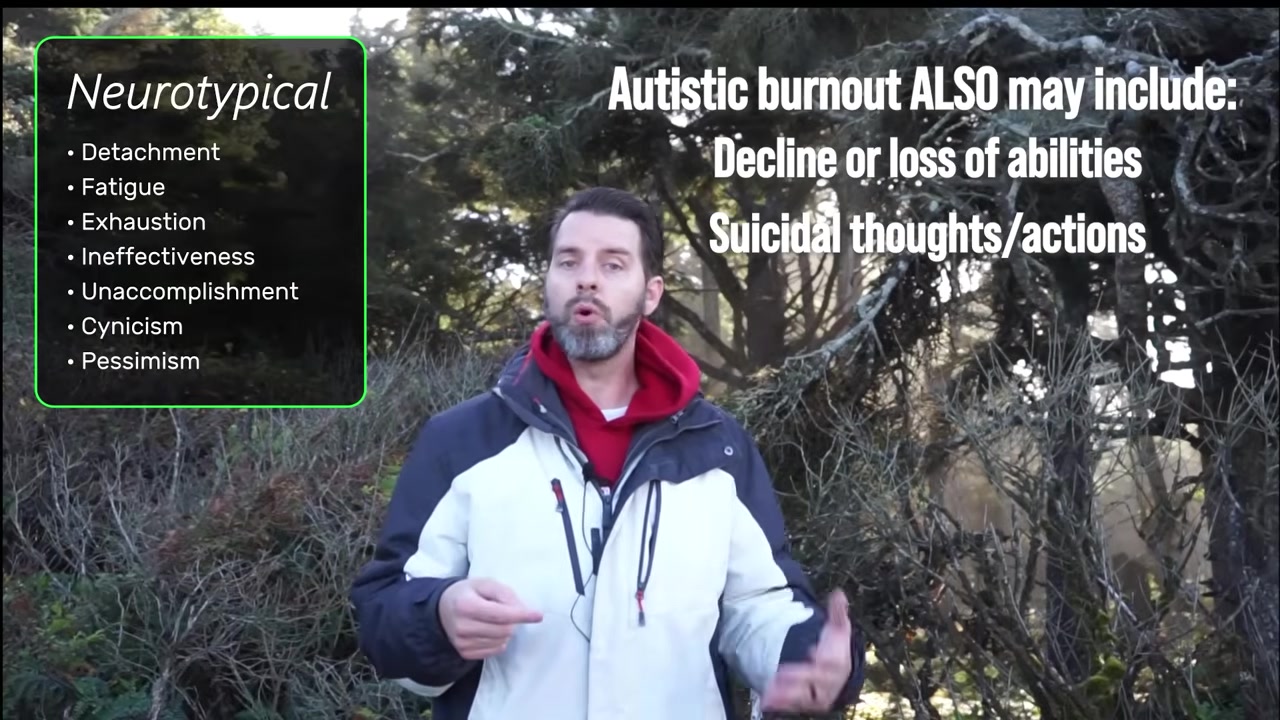
When people hear "burnout," they typically think of emotional exhaustion from work, social disconnection, cynicism, and decreased productivity. Impossible deadlines, rude colleagues, and the emotional toll of long-term caregiving are common causes. While general burnout is difficult enough, autistic burnout operates on an entirely different level.
Raymaker's research team (2020) defined autistic burnout as "chronic fatigue, loss of function, and reduced tolerance to stimuli." The critical difference is "loss of function." A person experiencing autistic burnout can temporarily -- or sometimes permanently -- lose basic abilities they previously had no trouble with, such as speaking, walking, and performing work tasks. This is exactly why the "just rest a bit and you'll be fine" approach doesn't work.
What's even more alarming is that autistic burnout can escalate to suicidal ideation and suicidal behavior. The hashtag #autisticburnout has gained widespread use as many autistic individuals share their experiences, and survey results show that 69% of respondents experienced autistic burnout at least once. This isn't simply "sensitive people exaggerating" -- it's a real crisis state that occurs when a neurologically different brain is exposed to unsustainable levels of stress.
"It is not simply a case of being tired and exhausted and something a Calgon bath and a little 'self-care' will take care of."
"Simply put, the expectations on them are greater than their ability to meet them."
How to apply: If you or an autistic person you know goes beyond "feeling a bit tired" and starts losing the ability to do things they could do before, consider the possibility of autistic burnout rather than general burnout.
2. The cost of "acting normal" all day -- How masking accelerates burnout
To understand autistic burnout, you first need to understand masking. Masking (camouflaging) is the act of trying to pass as neurotypical by mimicking the behaviors, communication styles, and skills of neurotypical individuals. This includes suppressing stimming (self-stimulatory behavior), hypervigilance about others' social behavior, and forcing eye contact.
According to a 2024 meta-analysis, masking is strongly associated with anxiety, depression, and reduced overall well-being. Autistic women in particular show higher levels of masking, which is one reason why autism diagnosis is often delayed for women. The constant self-monitoring and behavioral regulation consumes enormous energy, and this energy depletion leads directly to burnout.
Burnout also manifests differently across age groups. In children, it often appears as repetitive meltdowns or shutdowns, functional regression, and gastrointestinal issues. Children tend to revert to comfortable behaviors from earlier developmental stages when they can't cope with current stress. For adolescents and adults, it's accompanied by school or work refusal, intense fear/anger/depression/anxiety/apathy, emotional numbing, and physical symptoms like headaches, nausea, body aches, and fever.
As we age, life demands increase, but the aging brain becomes less adaptable to stress and produces fewer "feel-good" neurochemicals. This creates a vicious cycle where the patience and ability to maintain masking diminishes, making us increasingly vulnerable to burnout.
"Masking, also known as camouflaging, is the act of trying to pass as neurotypical by mimicking the behaviors, communication styles, and skills of neurotypical individuals."
How to apply: Recognize the energy you're currently spending on masking, and create "safe times" during the day when you can take the mask off. Start by listing the situations where masking is most exhausting for you.
3. Sleep deprivation, GI issues, medication side effects -- Three hidden fuels accelerating burnout
Masking isn't the only cause of autistic burnout. Sleep deprivation acts like an express train to burnout. For adolescents especially, it's biologically natural to sleep late and wake late, yet the school system forces them to go against this by requiring early morning attendance. Adding religious classes or zero-period classes only makes things worse.
Gastrointestinal problems are another factor that can't be ignored. According to Gorrindo et al. (2012), up to 85% of children on the autism spectrum experience GI dysfunction. This isn't simple stomach trouble -- it's a chronic issue that places continuous strain on both body and mind while disrupting quality sleep. Moreover, medications prescribed to treat these issues can actually increase anxiety levels as a side effect.
Other medical conditions common in autistic individuals also fuel burnout: food allergies, seizure disorders, skin conditions, headaches, asthma, and immune disorders all add to physical stress. On top of this comes relationship stress. Because neurodivergent individuals often differ in relationship patterns and concepts, they're more vulnerable to stress from interpersonal difficulties.
Most concerning is research showing that chronic burnout can cause structural changes to the brain (Savic, 2015). Fortunately, Liston, McEwen, and Casey (2009) found results suggesting that appropriate rest and stress-reduction interventions can reverse cognitive decline. Full recovery is possible in some cases, but others may experience lasting effects. This is precisely why prevention and early intervention matter so much.
"Chronic conditions that lead to burnout can cause structural changes to the brain."
How to apply: Review your sleep quality, diet, gut health, and potential side effects of any medications you're taking. Burnout may not be solely a "mind problem" -- it could involve a complex interplay of physical factors.
4. From brain fog to giving up hygiene -- 12 red flags that appear just before burnout
Before full-blown burnout hits, there are always warning signs. Catching these signals early can prevent a complete collapse. Here are the 12 core warning signs:
First, executive function declines more than usual. Decision-making becomes harder, memory problems worsen, you become more scattered, and even speech may become disorganized. Second, you become more sensitive to sensory stimuli than usual. Third, autistic traits and behaviors become more pronounced, or you feel the need to mask far more intensely than normal. Fourth, physical symptoms appear: body aches, pain, and headaches.
Fifth, feelings of helplessness and hopelessness set in. Sixth, meltdowns or shutdowns feel imminent or become more frequent. Seventh, the urge to escape from reality grows stronger than usual. Eighth, personal hygiene and self-care start to slip.
Ninth, desire for social activity decreases (and if you already dislike socializing, it drops even further). Tenth, "brain fog" sets in -- that feeling of your head being clouded. Eleventh, you experience more extreme fatigue than usual. Twelfth, the motivation to start tasks you need to do or want to do simply vanishes or diminishes.
If these signs are appearing, burnout is right around the corner. Immediate action is needed.
How to apply: Print out these 12 warning signs or save them in a notes app, and use them as a weekly self-check. If 3 or more apply to you, take immediate steps to reduce your stress load.
5. Cold showers boost dopamine by 250% -- A 5-step burnout emergency protocol
If burnout has already started, you need "burnout first aid." The first and most important strategy is to immediately change your environment. Since the environment is often the primary cause of burnout, the moment you feel burnout setting in, remove yourself from the situation. Go somewhere that makes you feel better and do something that helps. Simply resting in a place where you feel safe and respected can make a significant difference.
Second is harnessing the power of water. According to research published in the journal Medical Hypotheses, a cold shower at around 20 degrees Celsius (68 degrees Fahrenheit) immediately stimulates the brain's production of "feel-good" neurochemicals. Specifically, cold water immersion raises blood noradrenaline by 530% and dopamine by 250%. If cold water feels impossible, warm water is fine too (though the effect may be somewhat less). If showering is too difficult, splashing cold water on your face or placing a cold towel on the back of your neck can also help. During burnout, try taking multiple cold showers per day.
Third is deep breathing. It may sound cliche, but cliches exist for a reason -- they work. Deep diaphragmatic breathing that stabilizes the autonomic nervous system is scientifically proven. Fourth is emotional support animals. If you have a pet, hug them, pet them, and soak in the feeling of being loved. Bonding with animals promotes oxytocin release, which reduces stress.
Fifth is exercise and yoga. Exercise has been proven to immediately change a person's emotional and physical state. When blood circulation is activated, the brain floods with feel-good neuropeptides. Yoga in particular is especially effective for burnout recovery because it combines physical benefits with mindfulness.
"Hydrotherapy -- Don't let the simplicity of water throw you off."
"Deep breathing... it can seem cliche, but it is cliche for a reason... it works."
How to apply: Create a burnout emergency kit in advance: (1) a list of safe places you can escape to, (2) a cold shower routine, (3) a 3-minute deep breathing timer app, (4) a pet or comforting object, (5) a 10-minute light stretching routine.
6. "Rest to reset" and nature prescriptions -- How to truly recover from burnout
Once you've gotten past the emergency phase, you need a proper recovery stage. The key concept here is "Resting to Reset." This is different from just lying around doing nothing. Securing quality sleep comes first, which means reducing screen time (even though it's hard). Accept help from others and gently move your body with relaxing activities like yoga.
Get natural light and sunshine, take cleansing baths or showers, and during recovery, practice saying "no" to unnecessary appointments, meetings, substances like alcohol, and energy-draining expectations. The core is taking care of yourself.
The second key strategy is getting out into nature. As Florence Williams details in "The Nature Fix," nature's healing effects on the brain are scientifically proven. Beethoven, who was likely autistic, drew inspiration from trees and rocks. Nikola Tesla, another presumed autistic individual, conceived the electric motor during walks in nature.
Multiple countries worldwide prescribe forest therapy and ecotherapy programs as treatments for PTSD, ADHD, and other mental health conditions, with meaningful improvements in patients' lives. Time in nature isn't merely a "change of scenery" -- it enhances creativity and mood while creating positive neurological changes in the brain. For autistic burnout recovery, as much nature exposure as possible is essential.
"Resting to reset is different than just resting or laying around and not doing anything."
"It's not about going out and doing something nice in nature. No, it improves creativity and mood and makes good neurological changes to the brain."
How to apply: This week, spend at least 30 minutes in nature at least 3 times. Forests, parks, riversides, beaches -- anywhere works. Leave your smartphone behind if possible, or only use the camera function.
7. "Honor your autism" -- 6 practices to fundamentally prevent burnout
Preventing burnout in the first place is far better than recovering from it after it happens. The first and most fundamental principle is "Honor your autism." Accept that your autistic traits, characteristics, and behavioral patterns are part of who you are. If you need to stim, do it freely. If a meltdown comes, it's your brain and body signaling "get out of this stress right now." If you have special interests, make time to dive into them. Don't compare yourself to neurotypical people. Don't see yourself as flawed.
Second is identifying your triggers. Many people don't know their exact triggers. Create a trigger list and add new ones as you discover them. Share this list with people who can help. Interestingly, most people can handle one trigger, but two brings discomfort, three becomes very difficult, four puts you on the verge of meltdown, and beyond that, emotional meltdown becomes hard to stop.
Third is self-accommodation. Schools require teachers and staff to provide accommodations, so why not provide your own accommodations outside of school? For example: document self-accommodation rules like "I can take frequent breaks during difficult tasks," "I can delegate day-ruining tasks to someone else," and "I don't have to spend time with people who exploit my vulnerabilities."
Fourth is requesting workplace accommodations. Ask for things like standing desks, spaces with adjustable lighting, seating far from restrooms, and remote work options. Employers know that you need to function to contribute to the company, so most will be happy to help.
Fifth is advance planning and escape plans. Plan routes, rest spots, and food options for places you need to go. Always have an escape plan for events. Arrange signals with a partner or friend ahead of time so you can naturally slip away when needed.
Sixth is getting the people around you on your side. Let the people you spend time with know what you look like when you're becoming overwhelmed. When they can spot the signs, you can quickly remove yourself from the situation and begin recovery. Since many people can't recognize their own signals, having someone watching out for you is enormously helpful.
"My Number one rule is: Honor your autism."
"Do not see yourself as flawed. You are you. Honor yourself."
How to apply: This week: (1) document 5 self-accommodation rules, (2) start creating a trigger list, and (3) share your overwhelm signals with one close person.
Action Checklist
Do today:
- Create a 12-item burnout warning sign checklist and post it somewhere visible
- If you're currently showing burnout signs, immediately change your environment and try a cold shower
- Write down 5 of your triggers
This week:
- Document 5 self-accommodation rules (e.g., "guaranteed break time during difficult tasks," "permission to decline energy-draining social obligations")
- Share your overwhelm signals and meltdown signs with one close person
- Spend at least 30 minutes in nature at least 3 times
- Review your sleep environment: reduce screen time, create a bedtime routine
Long-term:
- Create a list of needed workplace accommodations and discuss with your manager or HR
- Consciously build environments and relationships where you can reduce masking
- Continuously update your trigger list and match coping strategies to each
- Read Florence Williams' "The Nature Fix" for the scientific evidence behind nature therapy
- Consider regular sessions with a neurodiversity-affirming therapist
Reference Links
References
- Dr. Service explains autistic burnout, how to stop it, how to recover, and how to prevent it. - Neurodivergent Doctor (18:24)
Related Tools
| Tool | Purpose | Price | Link |
|---|---|---|---|
| The Nature Fix (Florence Williams) | Scientific exploration of nature's effects on the brain and health. Covers forest therapy and ecotherapy programs in Korea, Finland, the US, and more. | Book (approx. 16-18 USD) | Learn more |
| Neurodivergent Doctor website | Dr. Anson Service's official site. Provides autism/ADHD resources, ASD-friendly provider directories, and more. | Free (blog/resources) | Learn more |
| Neurodivergent Insights | Detailed one-page guide on autistic burnout. Practical information on burnout vs. depression, recovery strategies, and more. | Free (article) | Learn more |
Related Resources
- Raymaker et al. (2020) - Defining Autistic Burnout (Article) - The groundbreaking paper that first academically defined autistic burnout through thematic analysis of 19 interviews.
- Autistic Burnout Measurement Tool Development (Mantzalas, 2024) (Article) - Research on developing a validated tool for accurately measuring autistic burnout.
- Understanding Autistic Burnout - National Autistic Society (UK) (Article) - The UK National Autistic Society's guide to autistic burnout for both professionals and individuals.
- Adapted cold shower as a potential treatment for depression (Article) - Research on the antidepressant effects of cold water showers, published in Medical Hypotheses.
Fact-Check Sources
- Raymaker's team defined autistic burnout as "chronic fatigue, loss of function, and reduced tolerance to stimuli" -> https://pmc.ncbi.nlm.nih.gov/articles/PMC7313636/
- Up to 85% of autistic individuals experience GI problems (Gorrindo et al., 2012) -> https://pmc.ncbi.nlm.nih.gov/articles/PMC3335766/
- Cold water shower at 68F (20C) stimulates feel-good neurochemical production -> https://pubmed.ncbi.nlm.nih.gov/17993252/
- Chronic burnout can cause structural changes to the brain (Savic, 2015) -> Research paper-based verification
Questions to Consider
What situations in your current life consume the most energy through masking? Is there a way to change or reduce those situations?
Of the 12 warning signs, do any currently apply to you? If so, what's one thing you could do today to reduce your stress?
What would it concretely look like to "honor" your autism (or neurodivergence)? Are there aspects of yourself that you're currently suppressing?
Key Takeaways
- 1Create a 12-item burnout warning sign checklist and post it somewhere visible
- 2If you're currently showing burnout signs, immediately change your environment and try a cold shower
- 3Write down 5 of your triggers
- 4Document 5 self-accommodation rules (e.g., "guaranteed break time during difficult tasks," "permission to decline energy-draining social obligations")
- 5Share your overwhelm signals and meltdown signs with one close person
- 6Spend at least 30 minutes in nature at least 3 times
- 7Review your sleep environment: reduce screen time, create a bedtime routine
- 8Create a list of needed workplace accommodations and discuss with your manager or HR
- 9Consciously build environments and relationships where you can reduce masking
- 10Continuously update your trigger list and match coping strategies to each
- 11Read Florence Williams' "The Nature Fix" for the scientific evidence behind nature therapy
- 12Consider regular sessions with a neurodiversity-affirming therapist
Want to read this later?
Save this insight to access it anytime