Lesson 4 / 5 in Product & Development
Analyzing 8 AI Apps Making 2 Million Dollars Monthly: 3 Formulas for Hitting Millions with One Simple Feature
TL;DR
After analyzing over 100 viral AI apps, the successful ones all use the same formula: 'long onboarding + hard paywall + one core feature' — and the real battleground isn't app development, it's marketing.
Analyzing 8 AI Apps Making 2 Million Dollars Monthly: 3 Formulas for Hitting Millions with One Simple Feature
One-Line Summary
After analyzing over 100 viral AI apps, the successful ones all use the same formula: 'long onboarding + hard paywall + one core feature' — and the real battleground isn't app development, it's marketing.
Key Numbers & Data
| Metric | Value | Context |
|---|---|---|
| Cal AI Monthly Revenue | 2M+ dollars | AI calorie tracking app, built by teenage founders earning over 2 million dollars per month |
| Learna Monthly Revenue | 2.4M dollars | AI language learning app, running 700+ Facebook ads simultaneously |
| LazyFit Monthly Revenue | 700K dollars | Home workout app, running 640+ Facebook ads simultaneously |
| App Development Cost | 500 to 2,000 dollars | Complete 70% with vibe coding, outsource the remaining 30% to freelancers |
| Marketing is Success Factor | 90% | Building the app isn't the hard part; the real battle is content and paid ads |
| Global Subscription App Market | 79.5 billion dollars (2025) | iOS accounts for 73% of all subscription revenue; mobile app market growing 15% annually |
Background: Why This Matters
As of 2026, the mobile app market integrated with AI is exploding. The global mobile app market is worth approximately 330 billion dollars as of 2025, and is projected to exceed 1 trillion dollars by 2034. Subscription apps alone generated 79.5 billion dollars in revenue in 2025, with iOS accounting for 73% of that.
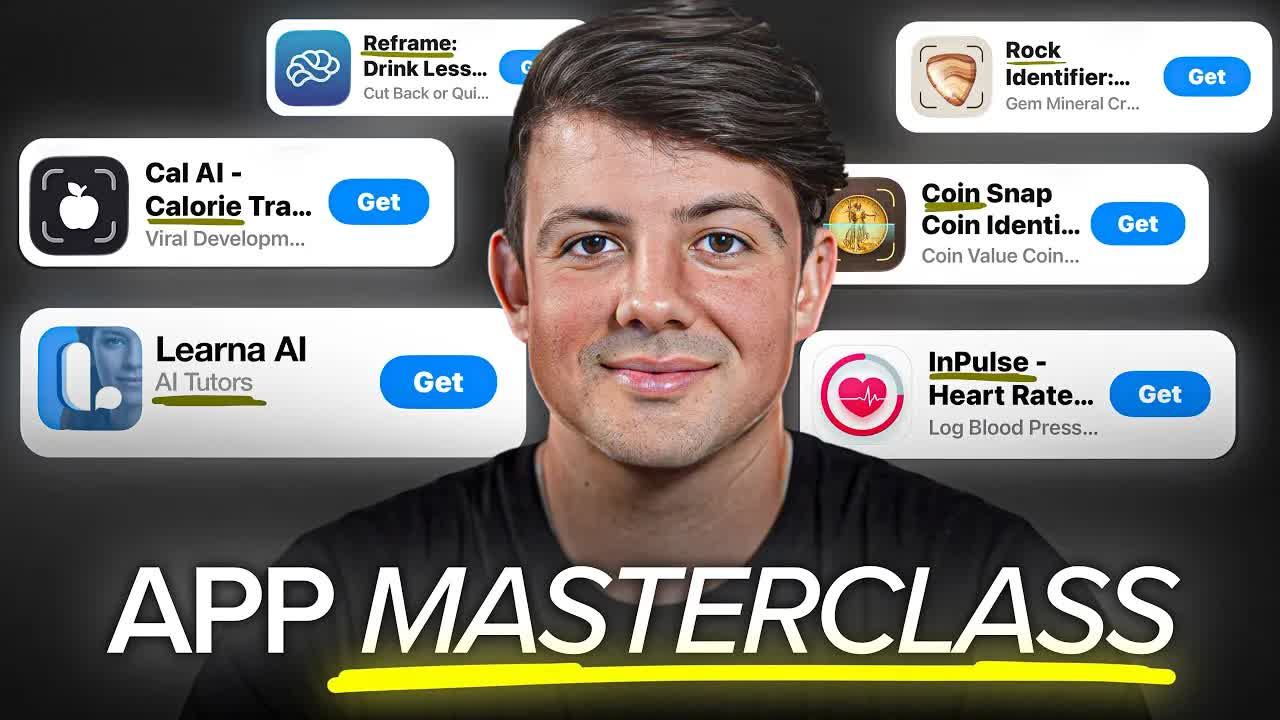
What's interesting is that the successful apps in this massive market are surprisingly simple. Cal AI is a calorie tracking app made by two 18-year-old CEOs — you take a photo of your food and AI tells you the calories. That's it. And it makes over 2 million dollars per month. Learna is an AI English learning app making 2.4 million dollars monthly, and LazyFit is a home workout app making 700K dollars monthly.
Thanks to a new paradigm called Vibe Coding, even people who know nothing about programming can build apps using natural language. Platforms like Replit, Bolt, and Emergent let you describe the app you want in plain words, and AI builds it for you. Building an app is no longer a barrier to entry. So what actually makes the difference?
There's a real case of someone who knew zero coding succeeding with this strategy. A 24-year-old founder who studied advertising and marketing at Pepperdine built a Wordle app at age 18 that got only 1-2 downloads per day for four years — until one day it suddenly hit 500,000 downloads in just 5 days. He then built PuffCount, a quit-smoking app, achieving 1,300 dollars daily and 40,000 dollars monthly revenue before getting it acquired. Now he runs Posted, a UGC marketplace, earning over 150,000 dollars per month. His philosophy? "95% of mobile app success is marketing."
The numbers really put this market into perspective. According to Fortune Business Insights, the global mobile app market is projected to grow from 330 billion dollars in 2026 to 1 trillion dollars by 2034 (CAGR 15.1%). RevenueCat's 2025 report shows subscription app revenue of 79.5 billion dollars with iOS at 73%. Apps with hard paywalls have 14-day RPI (Revenue Per Install) that's 8x higher than freemium models. The average mobile user spends 33.58 dollars per month on 2.4 subscription apps — there's plenty of pie to grab.
Key Insights
1. Successful AI Apps Do Just One Thing Well
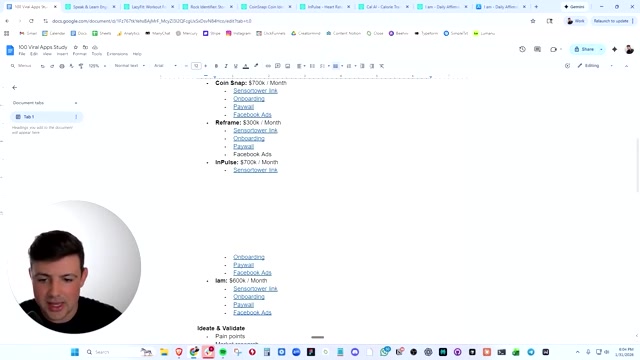
When you analyze hundreds of viral apps using Sensor Tower data, a remarkably consistent pattern emerges. Cal AI does one thing — take a food photo and get calorie info. LazyFit offers one thing — home workout routines. Rock Identifier does one thing — take a photo of a rock and identify it. CoinSnap does one thing — photograph a coin and appraise its value.
The monthly revenues of these apps are jaw-dropping. Learna at 2 million dollars per month, Cal AI at 2 million dollars, LazyFit at 700K dollars, CoinSnap at 700K dollars, Impulse at 700K dollars, I Am - Daily Affirmations at 600K dollars. All figures verified through Sensor Tower.
But here's the real kicker: none of these apps are technically complex. Hook up one AI API, slap on a clean UI, and you're done. Anyone with a vibe coding platform could build one in 2-4 weeks. So why are only these apps making millions of dollars?
"You'd be shocked at how simple these apps are."
How to Apply: Search for top apps in your category of interest on Sensor Tower. The first step is seeing for yourself that surprisingly simple apps are generating massive revenue.
Tools Mentioned:
- Sensor Tower - App revenue/download data analysis
2. The Secret of How a 3-Minute Onboarding Triples Conversion Rates
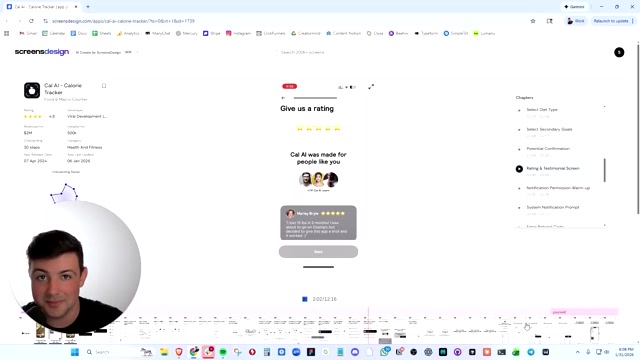
When you dissect Cal AI's onboarding process, it's incredibly sophisticated. Instead of showing users a paywall as soon as they open the app, it first takes them through a survey that lasts over 3 minutes. What's your target weight? Dietary preferences? Exercise frequency? Users answer each question one by one.
This works because of what psychology calls the 'Sunk Cost Bias.' People find it hard to give up on something they've already invested time and effort into. After spending 3+ minutes entering personal information, users develop a "I've come this far..." mindset, and when they encounter the paywall in that state, conversion rates are much higher.
What's even more clever is that they place 'priming screens' before the paywall. Cal AI uses a 3-stage paywall. First screen: "Try Cal AI for free" (this isn't the real paywall). Second screen: "We'll notify you before your free trial ends" (building trust). Third screen: Only then does the actual payment screen appear.
Through this 3-stage priming process, users already feel "Oh, this app is trustworthy" and "It's a free trial, so no pressure." Another pro tip: these apps request App Store ratings during the onboarding — before the paywall. That's how Cal AI maintains a 4.8 rating on the App Store. Users who get frustrated by the paywall never get the chance to tank the rating.
Reframe, another app, uses the exact same strategy. Long onboarding, custom plan generation, priming screens, hard paywall. Even the design is nearly identical. This isn't a coincidence — it's a proven optimal conversion formula.
"If a user opens your app and the first thing they see is a paywall, you can't convert anyone."
"This process builds an incredible amount of trust with users."
How to Apply: Design at least 5-8 onboarding survey steps for your app (or the app you're building). Make sure to include a 'free trial info' priming screen before the paywall.
Tools Mentioned:
- Superwall - Paywall management and A/B testing (free up to 10K MAR per month)
3. Why Annual Subscription Plans Create a 'Money Printing Machine'
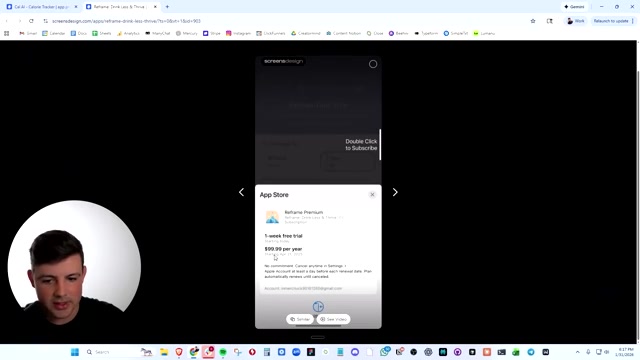
There's one standout commonality in every successful app's pricing strategy: offering free trials only on annual plans.
Cal AI: 29.99 dollars annually, 3-day free trial (annual plan only). Reframe: 99 dollars annually, free trial (annual plan only). LazyFit: 39.99 dollars annually, free trial (annual plan only).
This strategy is powerful because it maximizes LTV (Lifetime Value). If you charge 4.99 dollars monthly and a user churns after 3 months, you only make 14.97 dollars. But by guiding users to annual subscriptions, you collect 30 to 99 dollars upfront right after the 3-day free trial.
This directly ties into paid advertising. Higher LTV means you can spend more on CAC (Customer Acquisition Cost). Being able to outspend competitors on ads means you can acquire more users. According to RevenueCat's 2025 report, apps with hard paywalls have 14-day RPI (Revenue Per Install) 8x higher than freemium models, and LTV increases by almost 60% between month 1 and year 1.
Ultimately, these apps have created a 'money printing machine.' High LTV covers ad spend, ads bring in new users, new users subscribe annually which increases LTV further — a virtuous cycle.
"The higher your LTV, the more you can spend on paid ads."
"The reason these companies are printing money is simple: they're pushing more volume than you."
How to Apply: When setting your pricing strategy, always make the annual plan the default option and offer free trials only on the annual plan. Use A/B testing to find the optimal price, but start boldly high at first.
Tools Mentioned:
- RevenueCat - Subscription revenue management and analytics
4. The Marketing Secret Behind Apps Running 500-700 Facebook Ads Simultaneously
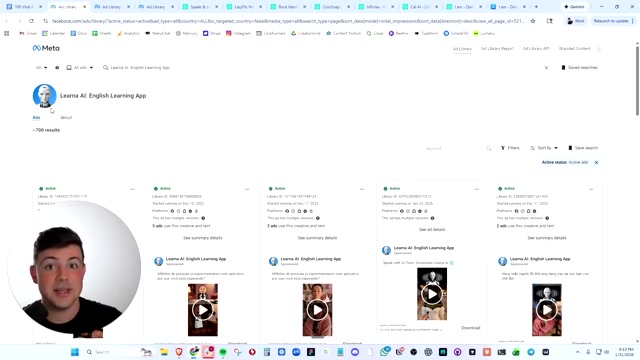
This is the really important part. Honestly, building the app is the easy part. The real challenge is marketing. It's no exaggeration to say that 90% of success depends on marketing.
Learna: 700 Facebook ads running simultaneously. Cal AI: 500 running simultaneously. LazyFit: 640 running simultaneously.
See the picture? These companies are literally running 'content factories.' And the key point is that every one of those hundreds of ads is profitable. They're not running ads at a loss.
Here's their marketing playbook. Step 1: Mass-produce UGC (User-Generated Content). Commission creators to make app review content. Step 2: Post this content organically on their own social media (TikTok, Instagram). Step 3: Identify the content that gets good views. This becomes 'validated content.' Step 4: Scale up the validated content through Facebook/TikTok paid ads.
This 4-step process is the core. Validate organically first, then scale with paid. Instead of burning money on unvalidated content, they only push content that's already proven to resonate, which is why their ROI is high.
There's a reason UGC content works especially well in the mobile app market: apps are products that need to be 'shown.' A 15-30 second short-form video of someone actually using the app has more persuasive power than any ad copy.
"Making content that converts, scaling with paid ads, and maximizing LTV. All of this requires A/B testing. This is what separates winning apps from losing apps in the App Store."
How to Apply: Create at least 10 UGC-style short-form content pieces per week. Post them on TikTok/Instagram to test engagement, then scale only the best performers through Facebook paid ads.
Tools Mentioned:
- Posted - UGC creator marketplace for mass brand content production
- Facebook Ads Library - Competitor ad creative analysis
5. A Realistic Roadmap to Build and Launch an App in 2-4 Weeks Without Coding
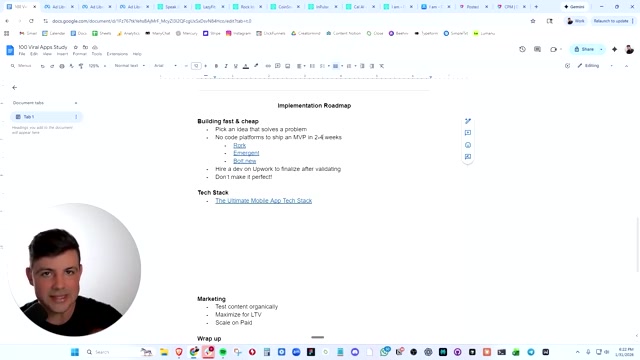
So how do you actually execute this? Let me lay out the most realistic roadmap.
Step 1: Idea Validation (1-3 days) First, identify a pain point to solve. Check competitor apps on Sensor Tower, verify search volume on Google Trends, and confirm whether content about the topic goes viral on TikTok/Instagram. If all three signal green, proceed.
Step 2: MVP Development (2-4 weeks) Describe the app you want in natural language on a vibe coding platform (Replit, Bolt, Emergent) and AI builds it. This gets you about 70% of the way there — clean frontend, basic functionality, UI/UX. Hire a freelance developer on Upwork to finish the remaining 30%. Cost: 500 to 2,000 dollars.
That 30% includes: bug fixes, App Store compliance, analytics integration (Mixpanel, Amplitude), paywall implementation (Superwall), and payment system integration (RevenueCat). These details are resolved much faster by experienced developers.
Step 3: Marketing & Scaling (ongoing) Once the app is out, jump straight into content production. It doesn't need to be perfect. Every successful app has bugs and bad reviews. What matters is speed. Build fast, get feedback fast, fix fast.
One piece of advice that's actually used in the industry: "Spending 6 months building a perfect app is worse than shipping an 80% app in 2 weeks and improving it with user feedback by 10x." In 2026, platforms like Emergent (Y Combinator backed, 300 million dollar valuation) have AI agents that automatically handle design, coding, and deployment.
"Don't spend more than 2-4 weeks on app development."
"Build on a vibe coding platform, hire a developer to finish it up. That's all there is to it."
How to Apply: Sign up for Replit or Bolt this week and input one app idea you're interested in using natural language. You'll be surprised how quickly a prototype comes together.
Tools Mentioned:
- Replit - Vibe coding platform, build apps with natural language
- Bolt.new - AI-powered full-stack app creation
- Emergent - AI agent-based app development (YC, 300M dollar valuation)
- Upwork - Freelance developer hiring platform
- Google Trends - Search trend verification and idea validation
Action Checklist
Today:
- Check top app revenue in your category of interest on Sensor Tower
- Save screenshots of 10 ad creatives from successful apps on Facebook Ads Library
- Download Cal AI, LazyFit, Reframe, etc. from the App Store and experience their onboarding
This Week:
- Validate 3 pain points using Google Trends and TikTok
- Build a prototype of one app idea on Replit or Bolt
- Document the paywall structure and pricing strategy of 5 competitor apps in a spreadsheet
Long-term:
- After MVP launch, build a system to produce 10+ UGC content pieces per week
- Start paywall A/B testing with Superwall and find optimal pricing
- Scale the top 10% of organic content through Facebook paid ads
References
Related Tools
| Tool | Use Case | Pricing | Link |
|---|---|---|---|
| Sensor Tower | App download, revenue, and ad analytics platform | Free plan available; paid 25K-40K dollars/year | Go |
| Superwall | No-code paywall management and A/B testing | Free up to 10K MAR/month, then 0.20 dollars per conversion | Go |
| RevenueCat | Subscription revenue management, analytics, paywall experiments | Free up to 2,500 dollars MTR/month | Go |
| Replit | Vibe coding platform, build apps with natural language | Free plan available, Pro 25 dollars/month | Go |
| Bolt.new | AI-powered full-stack app builder | Free plan available | Go |
| Emergent | AI agent-based app development, YC-backed, 300M dollar valuation | Invite-based | Go |
| Posted | UGC creator marketplace | Free to start, pay only for approved content | Go |
| Upwork | Freelance developer hiring | Varies by freelancer (500-2,000 dollars for MVP finishing) | Go |
Related Resources
- State of Subscription Apps 2025 - RevenueCat (Article) - Subscription app market landscape and benchmark data
- How Cal AI Built a 1M/Month App as Teenagers (Article) - Cal AI founder interview and growth strategy details
- 100 Viral Apps Study (Analysis Document) (Tool) - Original analysis of 100 viral apps (free download)
- Mobile App Onboarding: 5 Paywall Optimization Strategies (Article) - Practical guide to mobile app onboarding and paywall optimization
- What is Vibe Coding? Complete Guide 2026 (Article) - Vibe coding concept and major platform comparison
Fact-Check Sources
- Cal AI 2M dollars monthly revenue → https://www.cnbc.com/2025/09/06/cal-ai-how-a-teenage-ceo-built-a-fast-growing-calorie-tracking-app.html
- Learna 2M dollars monthly revenue → https://app.sensortower.com/
- LazyFit 700K dollars monthly revenue → https://app.sensortower.com/overview/1669413773
- 70% completion possible with vibe coding → https://emergent.sh/learn/best-vibe-coding-tools
- App development cost 500-2,000 dollars → https://upwork.com/
Questions to Consider
Among the recurring inconveniences (pain points) people around you experience, is there one that could be solved with a single simple AI feature?
If you had exactly 2 weeks to build an app, which single feature would you build?
Among the subscription apps you currently use, which one had a particularly great onboarding experience? Why did you end up paying?
Key Takeaways
- 1Check top app revenue in your category of interest on Sensor Tower
- 2Save screenshots of 10 ad creatives from successful apps on Facebook Ads Library
- 3Download Cal AI, LazyFit, Reframe, etc. from the App Store and experience their onboarding
- 4Validate 3 pain points using Google Trends and TikTok
- 5Build a prototype of one app idea on Replit or Bolt
- 6Document the paywall structure and pricing strategy of 5 competitor apps in a spreadsheet
- 7After MVP launch, build a system to produce 10+ UGC content pieces per week
- 8Start paywall A/B testing with Superwall and find optimal pricing
- 9Scale the top 10% of organic content through Facebook paid ads
Want to read this later?
Save this insight to access it anytime
Original Video
월 200만 달러 버는 AI 앱 8개 분석: 단순한 기능 하나로 수백만 달러 찍는 3가지 공식